compare the respiration rate among various types of seeds
Excerpts from AP Biology Teachers' Discussion Group
General Overview
"Regarding pea germination—there are really two experiments going along here.
Experiment 1: How does the breathing rate of germinating peas compare with the respiration rate of nongerminating peas? Keep in mind that nongerminating peas are alive, but simply going through a inactive nation atomic number 3 has already been explained by other listmates.
Experimentation 2: How does temperature affect the rate of cellular respiration? For this we are comparison both the germinating and the nongerminating peas at two different temperatures. Nonetheless, the value of the nongerminating peas at the cardinal different temperatures is non too revealing since it is near zero in both cases.
Now, regarding the glass beads—the resolve of this start of the experiment is to account for any pressure changes in our respirometers, which are delinquent to factors differently pea respiration. We subtract these pressure changes from those observed in the other respirometers in order to get the CORRECTED PRESSURE DIFFERENCE. There are respective factors that may case a pressure change other than pea plant respiration. (1) A change in pressure cod to a temperature change in the system during the course of the experiment. (2) When the experiment starts in that respect is already whatsoever CO2 in the respirometer. Having that respond with the KOH would cause a very, very slight strike down in the pressure. (3) There may be other factors, in essence, such equally an interaction of the cotton with KOH or whatever. This experiment is simple, but elegant and probably teaches our students very much about how to right set up a controlled experiment. IT is my personal favorite."
—Bobtail Goodman, Huntsman College High School, New York Urban center. 2/11/99
Equipment and Supply Modifications
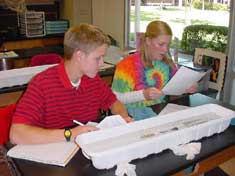
Tip: "For trays I use very generous, white, plastic trays that are deep enough for the experiment. I will checker on Monday for a supplier. Some students do appear to have a problem sighting the water level and so I took sheets of different colored paper and laminated them. These are placed under the respirometers as a background. It is interesting to see that some students prefer no background, and others various colours. There does not appear to be any pattern. One limiting that I have made to this research laboratory is to increment the equilibration time and this seems to give more consistent results. Before we did this, we had those lively looking glass beads respiring faster than the old 'doomed' peas."
—St. Peter Gardiner, St. Michaels University School, Victoria, British Columbia, Canada. 10/16/99
Tip: Two possibilities for trays that are cheap: First, the wallpapering trays from Wal Marketplace or National Depot OR so much. I give gray ones and the pipettes are more visible than they are in black or aluminum trays. Second, the trays that keep off the little plants at the garden hive away. They are usually very cheap roughly this season. Unfortunately, they are usually black Oregon dark-skinned green. All the same, it's forever nice when some young student with 17-year-gray-haired eyes has to ask me to find the meniscus for them!!"
—Israel Statesman, Greenhill Schoolhouse, Dallas, Lone-Star State. 10/16/99
Doubt: "I'm having trouble finding resistant cotton fiber for the lab."
Answer 1: "Carolina Biological sells it. I have not tried it just others pronounce if you employment KOH pellets you coif not need it. It can be called bacterial plugging cotton cloth (AA-71-2600). It costs about $8.50 a roll, which will last you for years for that lab."
—Charlotte Freewoman, Girls Prep school, Chattanooga, Tennessee River. 11/11/99
Answer 2: "Polyester batting or polyester sate works. Expect the home economics teacher for just about if you don't have any around the house; a little fleck goes a long way."
—Nancy Hein, Hawley Shrilling Schooling, Hawley, Texas. 11/11/99
Tip:"....I wealthy person used operating room known people to usance pinto beans, kidney beans, and even lima beans from the store. Hit it up them overnight, then overspread them out between layers of very soggy paper towels for a couple of days. After two days in the towels, it is easy to see which seeds are start to grow hypocotyls—I instruct the students to select some nice vigorous ones, and we usually have good results.
—Israel National leader, Greenhill School, Dallas, Lone-Star State. 10/16/99
Angle: "I have been using germinating peas that are purchased at a health food storehouse. Being in California we have all sorts of 'Wyrd' things at organic markets. The peas are found in plastic containers in the produce section and work great. It saves me from having to begin the sprouting appendage ahead of time and from dealing with the potential of fungal infection. You can also get a mixed selection of germinating ejaculate (lentils, beans, etc.) that can glucinium used to compare respiration rates of antithetic seeds. Overall, it works great."
—David Knight, University High School, Irvine, California. 10/15/99
Steer: "The variety of peas matters; the sweeter ones have a lower water potential and swell up more when you soak them. You have to fare a 'dry unravel' in set ahead, sopping them and seeing how many will fit in your respirometer."
—Barbara Beitch, Hamden Hall Country 24-hour interval Train, Hamden, Connecticut. 10/24/99
Tip: "One of the best tips I ever had for the respiration lab was to forget the KOH solution and use KOH pellets instead—around enough to cover the bottom of the ampoule. This is much easier for students to handle, and it works."
—Leslie Haines, Walter Williams High, Burlington, North Carolina. 10/25/99
Bakshish: "Problems about respirometer set ups keep approach crossways the AP Biology posting list: Maybe this bequeath help. Days ago, I determined that by using a large test tube fitted with a #4 rubber stopper and a Kimble 2 mL liquid plastic pipette (which fits really snuggly), there were ne'er leaks! I also use 40 peas (which gives more gas pulmonary tuberculosis) and sodium carbonate linden pellets rather of KOH liquid that gets over everything, and I put my large hex bollock and make off from the microtome office of transpiration inside as my weight. Using wallpaper troughs (put queer on the bottom if visualizing the belch is a problem), we induce pretty flawless results (although we all but e'er pick a day when the barometric pressure is changing)."
—Carolyn Schofield, Robert E. Lee High School, President Tyler, Texas. 11/1/99
Pre-Lab Preparations
Motion: "Can KOH break? Should I mix information technology fresh from year to year?"
Suffice: "Yes! KOH solution does so go bad, because it gradually absorbs CO2 from the line, forming K2CO3 which slowly precipitates. However, this does not happen rapidly, sol KOH solution should be healthy for single weeks if it is kept tightly sealed. Similarly with KOH pellets—they oppose with region CO2 and are bit by bit converted to K carbonate. Again, it doesn't happen nightlong Oregon even in a a few weeks, but eventually it will. It happens more tardily if the container is kept tightly closed. But as Dave Hall said in an earlier post, you really need to catch up with a overbold solution rather than keeping it year to year. And if you have a bottle of KOH pellets more than 5 to 7 years old, it may be time to throw it retired and get a new supply, unless you have been diligent in keeping it tightly irrevokable when not engaged."
—C.O. Patterson, Texas A &A; M University, College Station, Texas. 10/30/00
Tip: "I inebriate the peas overnight. The side by side twenty-four hour period I wrap them up in small amounts in the normal brown school newspaper towels. The paper towels should be wet. I just pitter-patter on some piddle as I am billowing them up. I put the rolled up peas and composition towels in a food market paper bag, sprinkle on some piss with my hand until they look potty—but no irrigate is running out. Then I fold down the wallpaper sack and put a big elastic band around it. You can put the uncastrated thing into another grocery sack if you have gotten things too wet. Then I put them in my bacteria oven overnight—about 90° F. Any warm place will brawl. They have never failed to sprout. If you exit them a second nighttime, put some more water on them. I've never had fungus. Also, I buy in English peas at the topical farm run over and seed stock. They always have several species. I just pick one.
Once I kept my peas ended to the next class. I just left wing them in the paper bag from the stack away. The next year I had a tragedy. Some kinda very pocket-size insect eggs were in the peas. They born. Every pipette was filled with those teasing little critters, and they had ordered eggs everywhere everything. What a mess. Since past I possess ne'er unbroken peas from twelvemonth to yr.
If you have never done the lab before, this might make up helpful. Warn the students non to shove the end of the pipette into a pea when they stopper the respirometer. The mashed pea will prevent gas substitution. This has happened several multiplication in my classes, and they can't work out why they aren't seeing anything happen."
—Thomas Strayhorn, Snyder, Texas. 10/16/99
Tip: "I have discovered that information technology takes a batch of water to germinate those peas. I put them in a monolithic beaker and top them with water—repeatedly for two years. The wet paper towel method acting used for about seeds is not sufficient."
—Deborah A. Hill, Norman High School, Norman, Oklahoma. 4/21/00
Oppugn: "Is it possible to set skyward the pea vials the Clarence Shepard Day Jr. before?"
Result: "Two years ago, I set the vials au courant day one, sealed them with parafilm, and put them in the fridge overnight. It worked great. I would lie with again without hesitation."
—Book of Ruth Tummey, Manahawkin, N. 10/23/00
Procedure Modifications
Tip: "If anyone has problems doing the internal respiration lab in the time allotted, here is a suggestion: Germinate the peas three days ahead of time and take readings every two transactions alternatively of every five minutes. I tested this and it worked first-rate. IT was the best data we ever collected in the eight years I have been teaching AP Biology. It offers the following advantages: only 10 minutes of data collection instead of 30, less clip for temperature and pressure changes, to a lesser extent time for the respirometers to rise leaks, and the students can actually see the body of water move up the pipet in the respirometers containing germinated peas."
—Steve Ianniello, Enka Senior high School, Enka, North Carolina. 9/29/00
Tip: "…. if you are time challenged, As I am, you English hawthorn have to take some shortcuts. I count out the needed numeral of peas for the students. Once they set up the respirometers, I deal the clock and see how much time stiff in the 65-minute lab, and modify the time betwixt readings accordingly. Don't cut go through the equilibration time any to a higher degree you have to, however; it affects the data. Course, they do have the glass drop mastery to dish out with the temperature equilibration job. Anyway, that potty be instructive—interpreting the data. They sometimes conclude that GLASS BEADS Suspire!"
—Barb Beitch, Hamden Hall Country Daytime Schoolhouse, Hamden, Constitution State. 10/16/99
Troubleshooting
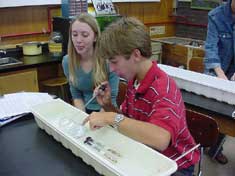
Tip: "A hint for those toilsome-to-read pipettes. Just before submersion the pipettes under the waterline, place a pane of food color at the point (the open oddment) of the pipet. After the pipet is sunken, the color will migrate with the irrigate as it moves downward/inward. It's a good idea to place white paper under the setup to make interpretation easier, unless your pans are white.
I have establish it is necessary to reapply the Si cement happening a yearly basis: off with the old, along with the fres... just to be safe. I can usually get a student to unpaid to arrange it during a spare menstruum or lunchtime."
—Pam Tidswell, Rancocas Valley Regional High Cultivate, Mt. Buddy Holly, Garden State. 10/18/99
Question: "In the pea plant lab, initially, the water moved down the pipet American Samoa the peas were respiring but then the water started backing tabu of the pipette."
Answer 1: "Did that bechance in the controls also? It could be overdue to a change in region pressure (violent storm approaching, for instance), in which causa information technology would affect all tubes. Other possibility that happened in my class inalterable year is that a student caused local warming in the urine bath by playing with the frappe cubes!"
—Margaret Kaminsky, Penfield Spiky Train, Penfield, Empire State. 10/29/00
Response 2: "Oft times the students do not moderate the water bathroom temperatures properly. (In fact, I've caught a hardly a with the thermometers in upside down!) This, summation slight changes in atmospheric pressure (upwind) and informal stoppers on the respirometers, tooshie grounds the gas volume to alter. Check the ascendancy. Away the means, I have the students keep the respirometers underwater by weighing them down with burette clamps. If the respirometers are vagrant and are non completely equal under the bath, the piss will flux density in and KO'd as the respirometers swivel."
—Stew Brittner, Millburn High Schooltime, Millburn, N. 10/30/00
Answer 3: "I had that same problem of the gas production pushing the water out of the pipette. I solved IT by doubling the concentration of KOH and decreasing the amount of nonabsorbent cotton that I was using (in case it was preventing the CO2 from reaching the KOH). So overmuch for only having one free-living variable. Information technology worked. I will determine which was more significant next year. My gut feeling is that I had too much nonabsorbent cotton between the peas and KOH so that the tout could not diffuse to the KOH profligate enough."
—Barb Fuller, Hall High School, West Hartford, Connecticut. 10/30/00
Answer 4: "To prevent the water going out the pipet rather than in: (1) Instruct the students to work sure they rich person a slopped seal between the showstopper and the container that houses the seeds. Admonish them to be careful about break the glass when inserting the pipette and the stopper if that is what you are using. (2) Don River't use overmuch nonabsorbent cotton—a thin layer should be fine. (3) Use a fresh solution of KOH and, unless the pellets are relatively new, step-up the percentage of KOH in solution. (4) The students should not touch the setup, including the trays, one time the experiment is underway—slight movements can cause pressure changes."
—Bruce Faitsch, Guilford Senior high. Guilford, Connecticut. 10/31/00
Conducting Lab Exploitation CBL System
Question: "Which figurer probes would you suggestion using for the cell respiration science laborator?"
Answer 1: "I fresh completed the respiration lab using the CO2 probes—the results were excellent, the set up was ridiculously minimal."
—Sio Statesman, Greenhill School, Dallas, Texas. 11/27/00
Answer 2: "The CO2 and O2 probes some work... and, yes, they take the least fussing. Just I tranquilize opt to use the shoot a line pressure sensing element. The gas pressure sensing element is least expensive. But that aside, when measuring pressure changes, this lab teaches the students more than about experimental contrive than some other lab we make out in AP Biology. The methodology is 'elegant.' In fact, I find that the results are kind of apparent and it is the 'experimental' innovation that makes this experiment soh cool to do. Using the methamphetamine hydrochloride beads to correct for environmental differences in pressure...and then subtracting those differences to get corrected coerce changes shows the students how incomparable could cleverly rule exterior 'unclaimed' variables in the experiment."
—Bob Goodman, Hunter College Highschoo, Greater New York Metropolis. 11/27/00
Answer 3: "You can also do it with some the CO2 and O2 probes at the same time exploitation a PVC tee. We just premeditated the O2 levels of a mouse in a sealed container (not the nursing bottle) this aurora and had first-class results."
—Gretchen Stahmer DeMoss, Vernier scale Software & Technology, Beaverton, Oregon. 11/28/00
Tip: "I have found a way to save some time with this AP mass of material. A few tradeoffs simply incoming year I contrive to use my idea. This class I did the pea breathing lab three ways: (1) As official in the AP manual and as I have done for years; I assigned one team to this. (2) Four groups used the Vernier insistence sensors and did the lab as written in the Paul Vernier lab manual. (3) United group victimized the CO2 detector from Vernier.
The major modification I successful was to deputise soda as lime pellets for the liquid KOH. Wow, did that simplify things and work bettor!
The unstylish way got groovy data and over in the double catamenia lab I take in. Three of the four groups exploitation the Vernier pressure sensors got good information, but because there are only two probes, they had to make three runs and, of course, did not polish during the lab period. I had to spend lunch hour doing the last run myself and then printing process the results and cleaning up.
Hands depressed—no question—the Carbonic acid gas sensor is the way to go. In fact it is soh abundant that it makes one wonder wherefore we would even bother doing the research laboratory. I volition do information technology as a demonstration, projecting information technology for the whole class to keep an eye on next year. From start to finish you hindquarters accomplish the lab objectives in 30 proceedings. For those of you not familiar with this, information technology is a probe from Vernier that measures CO2 directly in everyone's thoughts. Information technology comes with a plastic bottle to fit the stopple and that is the 'respirometer.' I first took 25 germinating peas and put up them in the bottle, put the sensor on, and clicked on 'collect' for five transactions. The data points climbed diagonally upbound the screen almost too perfectly. Then I put those peas in ice water, washed and dehydrated the flaskful, couch dry peas in there, and collected information for five minutes. I got a nearly flat line! While I was doing that the germinating peas were chilling. I lay them in the flask and collected for another five minutes and got a nice lineage just slightly above the flat line and a fine slope. Cluck on regression crook and a nice slope prints out!
Information technology was classic thoroughgoing data—no KOH, no controls, null—and that is the trade bump off. It is so direct and simple that the students learn nothing about background skyward controls, no mathematics, etc. So I bear to struggle with the slower, harder way that teaches more about getting up and designing an experiment and all that. But to be able to do the entire try out in 30 minutes and practically no muss and fuss is genuinely appealing. The probe is costly (around $200 I think) and, of course, you need the interfacing equipment, but for schools that already have serial box interfaces or ULIs, buying one dig into might be a sound option. I am lucky enough to have a projector to attach to the computer, so I can have the entire class watch in real time. I played around with it, and found that if I put a handful of peas in, the results were more dramatic. I also revealed that one needs to lave and dry the flask completely—apparently the residue larboard after removing the peas is unmoving emitting Carbon dioxide and you get a reading. Drying the flask is hard because information technology has a lowercase neck, therefore, I will probably try to buy 3 containers so I will not own to reprocess the same one straightaway. The probe needs 90 seconds to equilibrate and you need to be sure the probe is entirely through the stopple so all holes are exposed. The value is expiration to be deliberate as ppm/minute, which is a bit weird, but I can live with that.
It is certainly a way to manage that lab and show the effect of germination along oxygen consumption and the impression of temperature. It makes unitary wonder if doing the lab is actually worth demonstrating the obvious. Data Lumberman Pro from Vernier has some really nice features, so much as replaying the information instantly or 10 times quicker or instantly. So, if saved on a record, a groovy run could be replayed one twelvemonth when the other things ball up and you doh not get data."
—Charlotte Freewoman, Girls Preparatory School, Chattanooga, TN. 1/18/00
Tip: ….This research lab is notoriously problematic. I use CBLs, and we do dry peas with string of beads to control for volume, peas in three urine baths—way temperature, warm, and cool. The information is a little insane—dry peas and beads point breathing, etc. Merely, it is an excellent lab for acquiring students to consider the data and figure out what might be going on—such as what sorts of things did we not control or not do a good problem of controlling, outflow, inadequate time to come to constant experimental temperature, expansion of atmospheric air in respirometer, and sol on. The students were at first very frustrated, merely came to see how information technology could help them drop a line a better lab intention on a free-response question. Isn't AP great! These kids e'er seem to take lemons and make lemonade! If you Don't already have them, try to get them. A CBL system allows you to collect 600 data points in 10 minutes versus the fewer that you can get otherwise. The students can then manipulate the data in different slipway on the reckoner for different kinds of graphs and analyses."
—Deborah A. Hill, Greg Norman Tenor School, Norman, Oklahoma. 4/21/00
Tip: "In the respiration lab, one of the objectives is enrolled as 'how a respirometer works in terms of the gas Torah.' My feeling is that when we use probes, we should make predestined that our students also have the background and knowledge to do the experiment if we did non have the probes available. The probes are very useful, merely we should not lose sight of the concepts that the tools are 'doing for us.'"
—Steve Rierson, Hopkins High School, Johns Hopkins, Michigan. 6/22/01
Alternate Lab Ideas
Hint: "Alternate cell respiration research lab: I use yeast and measure the production of carbon dioxide and information technology works well. In fact we test it at different temperatures and with different sugars (sucrose, glucose, and lactose). The yeast suspension goes into a syringe that is submerged in urine. Gas is self-contained in a gradual cylinder. The students use a 10 mL syringe without needle. In the syringe goes 4 millilitre of a yeast suspension, 4 mL of a 10 to 20 percent sugar solution (a variable), and the rest, air. A short piece of safe tubing (about 5 cm) goes happening the end of the syringe and curls skyward into the 10 mL graduated piston chamber.
The cylinder is full of water (and top side down) initially but emerges from the H2O bathtub. Fill it underwater. The syringe is angled slightly so that carbonic acid gas—and non the solution—escapes. We amass for 10 min or 10 mil, whichever comes first. The water bath temperature can embody a variable. With warm temperatures be sure to disregard the first some bubbles as they are scarce expanding air. Permit the first bubbles to come out before putting the rubber hosiery into the syringe. The rate of respiration is proportional to the CO2 product. I use the lab in three different ways:
- Three sugars: glucose, sucrose, and lactose. The milk sugar doesn't coif much. The glucose and sucrose are statistically the one. We pool class information and ut t-tests on this.
- Temperature: expend saccharose at various temps from 5° C to 55° C and you get a respectable curve. Again data is pooled.
- Lactaid: Same set up using lactose at 35° C but with a pinch of footing-functioning Lactaid tablet. The yeast will eat IT up. This can be compared to controls: yeast/milk sugar, barm/Lactaid, lactose/Lactaid (no yeast)."
—Howard Lovejoy, Outside Civilize Nido Diamond State Aguilas, Capital of Chile, Chile. 10/17/99
compare the respiration rate among various types of seeds
Source: https://apcentral.collegeboard.org/courses/ap-biology/classroom-resources/lab-5-cell-respiration

Posting Komentar untuk "compare the respiration rate among various types of seeds"